The great rules
These rules have been proven in projects and apply broadly.
Use SI-units within the system
When you have real-world values, use SI-units within the whole system.
| Measure | Name | Unit |
|---|---|---|
| Length | meter | m |
| Mass | kilogram | kg |
| Time | second | s |
| Electric Current | ampere | A |
| Thermodynamic Temperature | kelvin | K |
| Amount of Substance | mole | mol |
| Luminous Intensity | candela | cd |
When the environment (users, imported data, export formats) does require other units (e.g. if the user wants to input the data in inches or millimeters), do the conversion within a thin layer right at the boundary of the system.
The underestimated rules
This part contains rules that are often underestimated.
Possibilities increase complexity
Whenever there are multiple ways to achieve something, the overall complexity increases. Each possibility alone adds little complexity, but together they multiply. The complexities often do not add up (2+2+......+2+2=20), but multiply (2*2*......*2*2=1024).
Imagine a business process with 10 steps and each step has 2 variants. To test all variants of the business process, 1024 variants would have to be tested.
The rules of thumb
This part contains some rules of thumb that often apply.
Expect 2 to 10 times more effort
If you are not able to bear an increased effort of 2 to 10, you should not start the project.
Keep it small and simple
Software projects often grow significantly during development. If you do not start small and simple, the growth will exceed your project constraints.
When you need performance, design your algorithms accordingly
Choosing the right algorithm — O(n) instead of O(n²) — matters far more than optimizing individual steps.
When writing code, optimize for readability, not for performance
When you write code, optimize for readability, not performance. There will be very little code where you will have to sacrifice readability for performance.
Complex code is easier to write than to read
When you generate code that you think is hard to write due to its complexity, beware that you will have an even harder time reading it. When you write it, you are in a stream of thought where one leads to the other. When you return to the code a year later, you are not in the topic anymore and you may not have time to recreate the whole stream of thought again.
Linear code is simple code
When you can read a program sequentially, line by line, each line is a step, the code will be easy to understand. When you write code, think what it will look like when you step through the code with a debugger later. When you jump between files often, the code will not be easy to read.
The great questions
This part contains architectural questions that frequently come up.
Where to put the interface?
One frequent design decision is determining where to place interfaces in your architecture. There are three possibilities.
Independent Interface (I)

Client-Owned (A)
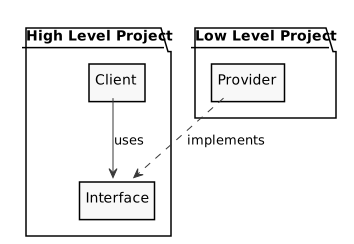
Provider-Owned (B)

| Interface location | Main benefits | Main drawbacks | Best fit |
|---|---|---|---|
| Interface project |
|
|
|
| High Level project |
|
|
|
| Low Level project |
|
|
|
If the client shall use a nice interface and the given provider interface does not really fit? Add an adapter class that implements the interface defined by the client and uses the interface defined by the provider.